

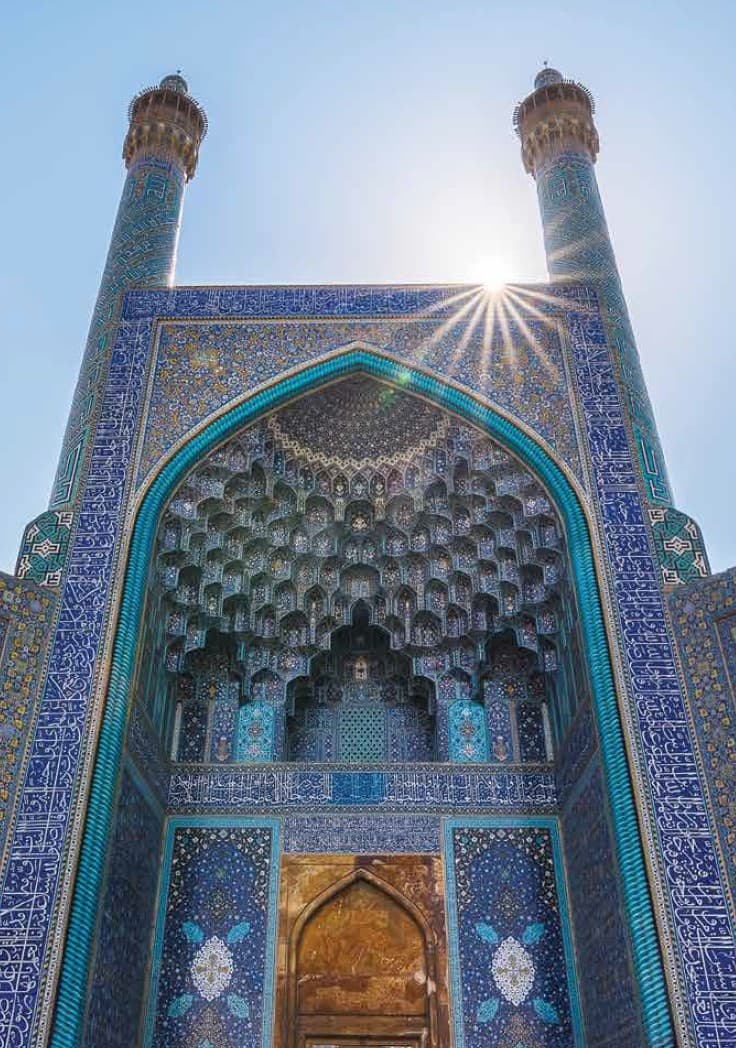
Imam Mosque (Masjid-e Jam ‘e Abbasi) is one of the
finest and the most stunning buildings in the world
standing in south side of Naghsh-e Jahan Square.
Built during the reign of Shah Abbas I, the Mosque
represents the culmination of a thousand years of
mosque building in Iran and a magnificent example
of Persian architecture, stone carving, and tile
works, with a majesty and splendor that places it
among the world’s greatest buildings. The Mosque
is also an excellent example of Islamic architecture
of Iran, and regarded as one of the masterpieces of
Persian Architecture. It is registered as a UNESCO
World Heritage Site along with the Naghsh-e Jahan
Square. Its construction began in 1611, and its
splendor is mainly due to the beauty of its seven-color
mosaic tiles and calligraphic inscriptions.
To the east and west of the mosque, there are two
madrasahs (theological colleges). Two long seminaries
at the back are suitably studious in their architectural
tranquility. According to A. U. Pope1 , both
the ground plan and the structure of the building
reflect the doctrinal simplicity of Islam. Circulation
and communication are everywhere facilitated, nowhere
impeded