

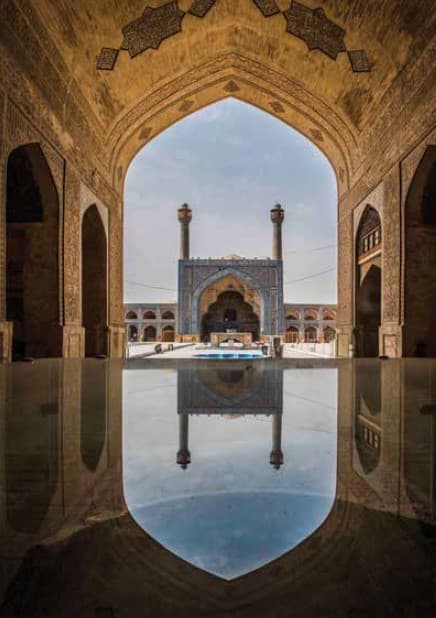
Located in the historical center of Isfahan, the Masjed-
e Jame (‘Friday mosque’) can be seen as a stunning
illustration of the evolution of mosque architecture
over twelve centuries, starting in 841 AD. It is
the oldest preserved edifice of its type in Iran and a
prototype for later mosque designs throughout Central
Asia which has been a UNESCO World Heritage
Site since 2012.
Covering more than 20,000 m2, the complex is also
the first Islamic building that adapted the four-courtyard
layout of Sassanid palaces to Islamic religious
architecture. Its double-shelled ribbed domes represent
an architectural innovation that inspired builders
throughout the region. The site also features
remarkable decorative details representative of stylistic
developments over more than a thousand years
of Islamic art. The prototype character is well illustrated
in the earliest double-shell ribbed Nezam al-
Molk dome, the first use of the four portico (Chahar
Ayvān) typology in Islamic architecture, as well as
the textbook character of the Masjed-e Jame’ as a
compilation of Islamic architectural styles.
The Masjed-e Jame’ of Isfahan is an outstanding example
of innovation in architectural adaptation and
technology applied during the restoration and expansion
of an earlier mosque complex during the Seljuq
era, which has been further enlarged during later Islamic
periods by addition of high-quality extensions